
Disclosure: This post contains affiliate links. If you click through and make a purchase, I may earn a commission at no extra cost to you. I only recommend tools I personally use and trust.
If you want to learn how to set up your first affiliate program from scratch, you’re in the right place. In my last post I went over how affiliate programs work, how commission structures differ, and which ones suit beginners.
Theory is the easy part. When I actually sat down to apply for my first program, I froze. Where do I even apply? What do they want from me? Would a brand-new site with no traffic get approved? And how do I add links without breaking the rules?
I’ve been through this a few times now, and I can tell you it isn’t complicated. So let me walk you through the whole thing, using my first program (Hostinger) as the example. Follow along and you’ll have everything set up in about half an hour.
STEP 1: PICK THE RIGHT PRODUCT TO SET UP YOUR FIRST AFFILIATE PROGRAM
Don’t spend a week comparing dozens of programs. For your first one, pick a product you already use and recommend in your writing.
That matters more than the commission rate. If you write about building websites, recommending a web host is a natural fit, and readers can tell when you’re speaking from experience. Push a product you’ve never touched and it shows. It reads like an ad, because it is one.
For most new niche site owners, there are two obvious starting points:
- Hostinger. Web hosting is something almost every site owner has to buy, which makes it easy to work into your content. Their affiliate program pays up to 40% commission on first-time hosting purchases. Their AI Builder / Horizons plans can pay up to 60% commission. This was my first program, and I got approved in about 48 hours on a site with almost no traffic.
- Rank Math. The SEO plugin you may already be running on your own site. It pays a 30% commission on each sale — roughly €17 for a Pro license and up to €149 for an Agency plan, depending on the tier. Any upgrades the customer makes within their first 60 days also count toward your commission.
One thing I’d skip as a beginner: affiliate networks like ShareASale. They carry more programs and more features, and they also come with more rules to learn. Start with a single brand program, get comfortable with the workflow, and only then move on to networks.
This is the single most important decision you make when you set up your first affiliate program.
STEP 2: FIND THE APPLICATION PAGE
I’ll use Hostinger here, but the process is basically the same for almost every brand.
You can go straight to affiliates.hostinger.com. Or you can do it the slow way: open the brand’s main site, scroll to the very bottom, and look for a small link that says Affiliates, Partners, or Referral Program.
Most brands bury this link in the footer, so if you can’t find it anywhere else, that’s where it lives.
Once you’re on the affiliate page, click the button that says Become an affiliate or Join now. That takes you to the application form.
Nearly every brand follows this same pattern, so you can reuse this exact process when you set up your first affiliate program.
STEP 3: FILL OUT YOUR APPLICATION
This is what the first page of the Hostinger affiliate application looks like.
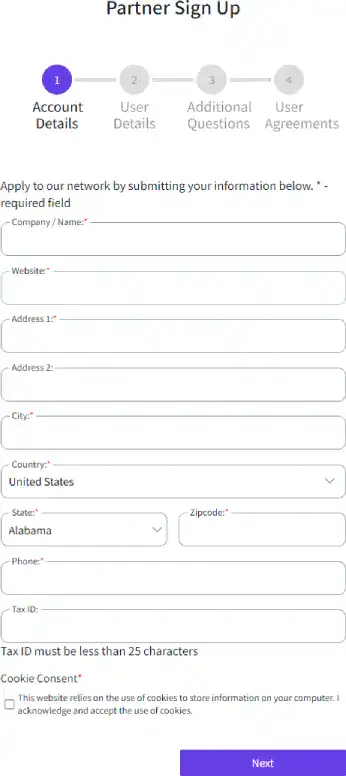
The form asks for a handful of standard details. Here’s how to fill them in so you don’t get rejected over something silly.
- Name, email, password. Your normal details. Nothing clever needed here.
- Website URL. Put in your own domain. I’d avoid submitting social media links. Most programs are built around independent websites and put real weight on them, so an application with only social profiles is more likely to get declined. A few programs (Hostinger included) do accept social and email promotion, but check the terms before you assume yours does.
- Promotion method. Pick Blog / Content Marketing. Don’t tick the paid advertising boxes. You’re writing honest recommendations, so this is the truthful answer, and choosing “paid ads” only invites scrutiny you don’t need.
- Payout method. Choose PayPal if it’s an option. Nearly every program supports it, payments arrive quickly, and setup is simple.
Then submit and wait. Some programs approve you instantly; others take a day or two for a manual review. Yes, a brand-new site can get approved. Reviewers care more about whether your content is relevant and genuine than how much traffic you have.
Fill it out this way, and you’ll avoid the most common reasons applications get rejected when people set up their first affiliate program.
STEP 4: GRAB YOUR UNIQUE REFERRAL LINKS
Once you’re approved, you get access to the affiliate dashboard. This is where you’ll spend most of your time from now on.
Every product and plan has its own link, tagged with your personal referral ID. It usually looks something like this:
https://hostinger.com/?REFERRALCODE=your-unique-id-hereThat code is what ties a sale back to you. When a reader clicks the link and buys, the system logs it against your account and adds the commission automatically. You don’t verify anything by hand. It happens in the background.
Copy the link for the product you’re recommending, save it somewhere you can find it, and you’re ready to use it.
One warning before you do. Don’t test your own links by clicking through and buying. Nearly every program bans self-referrals, and some will close your account over it. Rank Math spells this out explicitly: a purchase made through your own link doesn’t earn a commission.With your unique referral links copied, you’re officially halfway through the process to set up your first affiliate program.
STEP 5: ADD LINKS TO YOUR CONTENT (WITHOUT GETTING IN TROUBLE)
Pasting links wherever they fit isn’t just annoying for readers. It can also land you in trouble with search engines and regulators. The compliance part is where most beginners go wrong, so let’s break the two requirements apart, because they come from two different places.
Tag the link for search engines. Add rel="sponsored" to affiliate links. This is Google’s recommended best practice for paid links, so they don’t pass PageRank. rel="nofollow" also works, and using both is harmless. Most SEO plugins add them automatically. This is an SEO guideline, not a legal requirement.
Disclose the relationship to readers. This one is the legal requirement. The FTC (US) and ASA (UK) both mandate clear, conspicuous disclosure that you may earn a commission if readers buy through your links. I usually put a one-line disclosure right under the title. It’s honest, it builds trust, and readers barely notice it.
Don’t stuff links everywhere. Drop the link into the paragraph where you actually recommend the product. Skip the random links stapled to the top and bottom of the post. The more natural it feels, the more people click.
Follow these two rules, and you’ll stay fully compliant when you set up your first affiliate program and add links to your site.
STEP 6: UNDERSTAND THE COOKIE WINDOW
This is the part that trips up almost everyone, so it’s worth a minute.
When a reader clicks your affiliate link, the program drops a cookie in their browser. That cookie is what credits the sale to you, and it expires. Hostinger’s lasts 30 days. Rank Math’s lasts 60. If your reader buys while the cookie is still alive, you get paid. If they wait until day 90, you don’t.
Two things follow from that.
First, don’t expect instant credit from a click. Readers rarely buy on the first visit. A lot of your commissions will come from people who clicked weeks ago and only just pulled the trigger.
Second, the link has to be the last one they click. Most programs use last-click attribution, so if a reader clicks your link and then a competitor’s before buying, the competitor gets the commission. Not much you can do about it except pick products where your recommendation is the one that sticks.
So assume you have 30 days from the click. Write content that stays useful for months rather than days, and the cookie window quietly does the work for you.Understanding the cookie attribution window is a commonly overlooked detail when you set up your first affiliate program.Getting this attribution window right is key to setting realistic expectations when you set up your first affiliate program.
STEP 7: KNOW WHEN AND HOW YOU GET PAID
Once your links are live, the flow looks like this:
Reader clicks → buys → refund window passes → commission is confirmed → you request a payout → money arrives.
Two numbers worth knowing before you start, using Hostinger as the example:
- Minimum payout. You can’t cash out after one sale. Hostinger requires $100 and at least 3 approved conversions for a PayPal payout, or $500 and 3 approved conversions for a bank transfer. Rank Math’s threshold is $200.
- The waiting period. Hostinger only releases commissions older than 45 days, and you have to request your payout by the end of the month. Payments go out after the 15th of the following month. So realistically, your first payment lands one to two months after that first sale.
There’s also a refund rule that catches people off guard. If the customer cancels inside the refund window, the sale and your commission disappear. That’s normal. Plan for it.
And a reminder most posts skip: this is taxable income. In the US you may receive a 1099 form once you pass the reporting threshold. In the UK, you’ll need to declare it as self-employment income. Keep your own records from day one.Keeping clean income records is an often-forgotten part of the work when you set up your first affiliate program.
If you follow this checklist, you’ll have everything you need to set up your first affiliate program correctly on the first try.
QUICK RECAP
- Pick a product you already use and write about. Don’t chase a random high-commission offer.
- Find the program through the brand’s site, usually in the footer under “Affiliates” or “Partners.”
- Apply with your own website and select Blog / Content as your promotion method.
- Copy your unique links from the dashboard. Never test with your own purchases.
- Tag links with
rel="sponsored"and add a clear, reader-facing disclosure for FTC/ASA compliance. - Know the cookie window: 30 days for Hostinger, 60 for Rank Math.
- Know your payout threshold, the 45-day hold, and the manual request process.
FAQ
Q: Do I have to pay to join an affiliate program?
A: No. Every legitimate program is free. If someone charges you a “membership fee” or “training fee” to sign up, walk away. It’s a scam. This is true for every legitimate program you’ll set up.
Q: What if I only have social media, not a website?
A: Most reputable brands prefer applications with an independent website. A few do accept social-only promoters, but you’ll have an easier time everywhere if you build a simple blog first, publish three or four relevant posts, and then apply.A simple independent website will always give you much more credibility when you set up your first affiliate program.
Q: What if I don’t have PayPal?
A: Many programs also pay by bank transfer, Payoneer, or another method. Check the program’s payout page before you apply. PayPal is still the most widely supported option.
Q: What if my application gets rejected?
A: Read the reason. Most rejections come down to too little content, or content that doesn’t match the product. Publish a few more relevant articles, wait a couple of weeks, and apply again. Second attempts usually go through.A little patience and a few extra posts are usually all it takes to get approved when you set up your first affiliate program.
FINAL THOUGHT
If you’re still new to how affiliate programs work, start with my beginner’s guide to affiliate models first.
Applying to your first affiliate program looks like a long checklist, but it’s really an afternoon of clicking around. The slow part is everything after: writing content good enough that people actually want to click your links.Most people way overcomplicate the technical steps when they set up their first affiliate program.
Your task for today is small. Open the affiliate page for the product you want to promote, and read through the application form. You don’t have to apply yet. Just get familiar with the questions they ask. Half the hesitation disappears the moment you see them.
Next time I’ll take on the part people struggle with most: how to place affiliate links without sounding salesy. Where I put them, how I phrase a recommendation, and the few tricks that have worked for me.
If you want that one in your inbox, subscribe below.