
Disclosure: This post contains affiliate links. If you click through and make a purchase, I may earn a commission at no extra cost to you. I only recommend tools I personally use and trust.
Ever spent two weeks learning how to choose affiliate products to promote, picked one with a juicy commission, wrote two full reviews, then opened your dashboard a week later to find… nothing? Not one click. Not one sale.
I’ve been exactly there. A tool showed up in my affiliate dashboard paying a few dozen dollars per sale, and I didn’t overthink it. I wrote three posts in two weeks, polished every line, hit publish, and waited. Zero conversions.
My writing wasn’t the problem. The problem was the step before writing, the one nobody gets excited about: choosing what to promote.
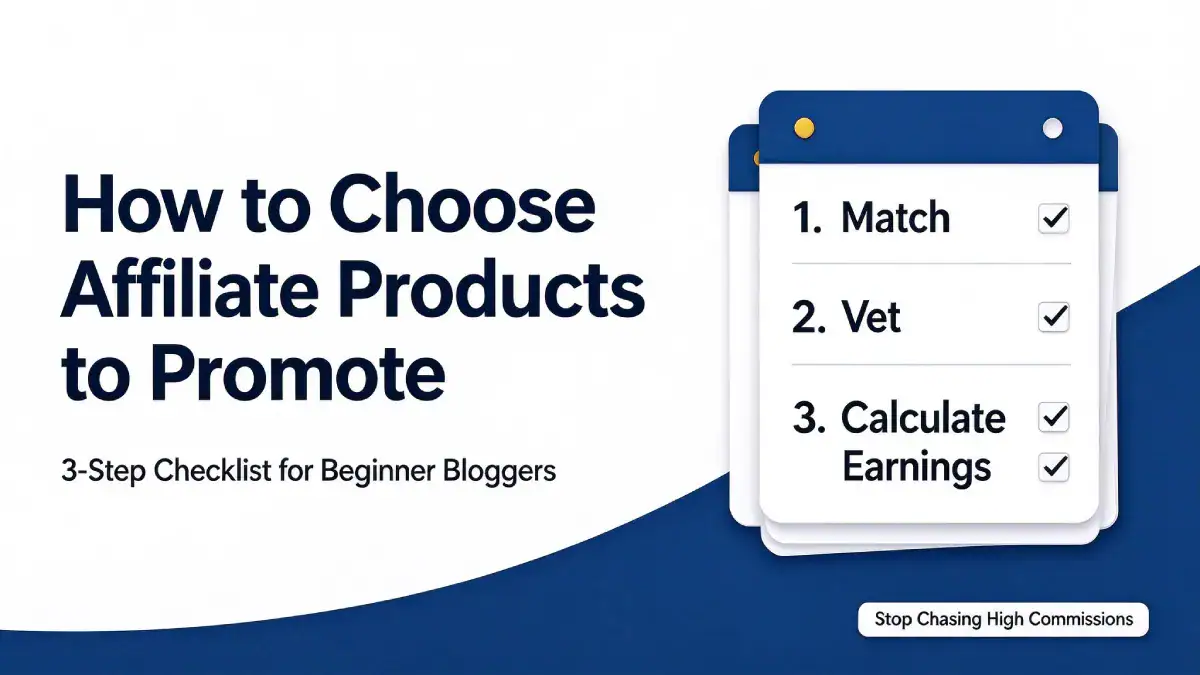
Most new affiliates do it backwards. They open the commission column, sort it highest to lowest, and start there. After enough flops, I learned to flip the order. Match first. Vet second. Calculate earnings last. The commission always comes last.
In this post, I’ll walk you through exactly how to choose affiliate products to promote using my proven 3-step method to decide whether an affiliate product is worth a single word. Every step comes from a mistake I made, so you can skip the costly version.
Pro Tip: Save this post. The next time a shiny commission tempts you, you’ll want the checklist nearby.
How to Choose Affiliate Products to Promote: Step 1 — Match
Before anything else, ask one boring question: do my readers actually want this?
Get it wrong here, and nothing later can save you. I see two traps over and over.
Trap 1: Chasing the highest commission
Think about it. If a product sold itself, would the company need to pay huge commissions to get bloggers talking? Often, a sky-high rate is a sign the product is hard to sell. And those offers usually have a line of established sites already promoting them. So when your reader searches, they land on a site they already trust, not the fresh link from a brand-new blog.
In my experience, the biggest commission in your dashboard is rarely the one that converts.
Trap 2: Turning your blog into a general store
I did this early on. Monday I’d promote hosting, Tuesday some random software tool, Wednesday a supplement that paid well. Readers got confused. Wait, is this a WordPress site or a shopping channel? Growth stalled, and the people who did subscribe didn’t stick around.
Once I narrowed my focus, everything changed. I picked one lane: hosting, plugins, themes, and SEO tools. Nothing outside it. Over time, readers started to associate a specific niche with my name. When they needed help with that one thing, I was the person who came to mind.
How to Tell What Your Readers Actually Want
Don’t guess. Use signals they’ve already given you.
- Your site’s search data. Look at the queries in Google Search Console, or what people type into your site’s internal search box. What readers actively search for is real demand.
- Your comments and emails. Which product do they ask about most? Write about that one first. The conversion rate is usually solid.
Pro Tip: Readers don’t need a product just because it pays well. If nobody is asking for it, no commission is high enough to make it worthwhile.
That’s the core rule of how to choose affiliate products to promote: match beats margin. If your reader doesn’t want it, you can’t sell it.
How to Choose Affiliate Products to Promote: Step 2 — Vetting
Your product matches your audience. Good. This is the most overlooked part of how to choose affiliate products to promote — don’t start writing yet. Run a background check first. This one is about your reputation, and it’s not the place to cut corners.
Two mistakes show up here constantly.
Trap 1: Faking a hands-on review
Years ago, I jumped on a niche plugin after installing it for five minutes. I wrote up the feature list straight from the vendor’s page, confident I understood it. Then a reader asked why it had a compatibility bug and how to fix it. I had no answer, because I’d never hit that bug. I’d never really used the thing. That comment stayed with me for a long time.
Ever felt that little drop in your stomach when someone asks a question you should be able to answer, and you can’t?
After that, I set one rule: if I haven’t used it, I don’t pretend I have. But realistically, you can’t buy everything you mention. Here are two honest ways around it:
- Label it as a roundup. Call the post a “research roundup” or a “head-to-head comparison.” You’re summarizing public information, not claiming personal experience. Skip phrases like “after using it for a month.”
- Buy it and use it for real. If readers ask about it constantly and you plan to write about this niche long term, buy the product and use it properly for 7 to 14 days before writing. That small cost pays itself back through commissions, and it’s far cheaper than burning trust.
If you want a proven structure for honest, high-converting reviews, see my guide on how to write a product review that converts.
Trap 2: Promoting something that isn’t reliable
This is the one that hurts most. Back when I first started building sites, I signed up with a cheap host that ended up vanishing. My data was gone, support went silent, and my money never came back.
Here’s the thing. When a product you recommend fails, readers don’t blame the product. They blame you. Trust you spent months building can disappear with a single bad recommendation.
Three Checks I Run Before Every Promotion
- Company background. Look up the business entity and how long its domain has existed. In my experience, small brands operating for under two years deserve extra caution.
- Negative reputation. Search “[brand name] + scam / shut down / complaints” and scan industry forums. Look for clusters of the same complaint, not one angry thread.
- Support quality. Email support yourself and ask a real question. Time the response and see if they actually solve it. If you can’t reach a human, your readers won’t be able to either.
One more thing belongs on this list: disclose your affiliate links clearly. The FTC’s Endorsement Guides require it, and readers respect the honesty.
For a full walkthrough of proper link formatting and clear disclosure, check out my guide to natural affiliate link placement.
Important: I’d rather lose one sale than damage my reputation. One bad recommendation can undo months of good ones.
If you can’t stand behind the product, don’t put your name on it.

Step 3: Calculate the Real Earnings, Not the One-Time Commission
You’ve matched and vetted. Now, and only now, the final step of how to choose affiliate products to promote: calculate real long-term earnings. But don’t stop at that single percentage in your dashboard.
Two long-term factors matter more than a fat one-time payout, and new affiliates tend to overlook both.
Recurring Commissions
Hosting, plugins, and similar tools bill customers every year. A renewal commission compounds over time, and it stacks up far higher than a one-off payout. This is the difference between a paycheck and an income stream.
Complementary Products
Sell someone hosting, and later they may need a domain, a CDN, or an email service, each with its own commission. One happy reader can turn into several sales.
That’s why I don’t just calculate “commission × conversion rate.” I ask whether this product can bring me repeated income over the years.
When I recommend a host, I recommend one I’ve actually used and trust, then let readers decide with the link. You can check it out here.
A small recurring commission usually beats a big one-time check.
A Newbie Approach vs. a Pro Approach
A quick comparison makes the whole mindset shift obvious.
❌ The newbie mindset (easy to crash and burn):
“This offer pays 60%. That’s huge. I’ll write a review today. Never mind whether I’ve used it, whether readers need it, or whether the brand is stable. Get the sale, figure out the rest later.”
✅ The steady mindset (built to last):
“Readers keep asking about this host. I’ve used it for six months and it’s been rock solid. The company’s been around for years with no red flags. The commission is only 30%, but it converts well and pays on renewals too. Worth writing about properly.”
Same product category. Completely different outcome. The newbie stares at one sale. The pro watches reader trust and long-term earnings. Different order, very different results.
Choose the order, and the results follow.
Quick Recap Checklist
Use this quick checklist to make sure you’re applying the full method of how to choose affiliate products to promote. Before you promote any product, run it through these five questions:
- Match: Does it fit my niche, and do my readers genuinely want it?
- Vetting: Have I actually used it? Are the brand’s reputation and support solid?
- Earnings: What’s the commission, and are there renewal or complementary-product income streams?
- Focus: Am I sticking to 3-5 core products instead of chasing everything?
- Boundaries: Would I still recommend this if it earned me nothing?
FAQ
Is a low-commission product worth promoting if it’s genuinely good?
Yes. When you choose affiliate products to promote, high conversion rates, repeat purchases, and a strong reputation often outperform a higher commission rate over time. Reader trust is the foundation of real, long-term affiliate income.
How do I decide whether a commission is worth my time?
Don’t look at the percentage alone. Think “commission × conversion rate × repeat purchases.” A 30% product that sells steadily and pays renewals can out-earn a 60% product nobody buys.
Can I promote a product I’ve never used?
Yes, you just can’t pretend you’ve used it. Call it a “research roundup” or a “comparison” and summarize the facts. The real danger is a fake hands-on review; that’s what kills your reputation when you learn how to choose affiliate products to promote.
How many affiliate products should I promote at once?
In my experience, 3 to 5 core products is plenty for most new affiliate sites. Fewer, more focused recommendations convert higher and keep your readers’ trust intact long term.
Final Thoughts
At the end of the day, learning how to choose affiliate products to promote comes down to one line: help your reader pick the right thing first, and think about your own earnings second.
Get the order right, and far less of your writing goes to waste. Get it wrong, and even great content struggles to convert.
If you want a starting point, the tools I use most are my recommended host and my SEO plugin. You can take a look here.
Your 5-Minute Action Step
Want to put what you learned about how to choose affiliate products to promote into practice right now?
Open your affiliate dashboard right now. List every product you’re currently promoting. Score each one on match, trust, and earnings. If something fails on match or trust, pause it today. Keep the three to five you’d genuinely recommend to a friend, and focus there.
Five minutes, one small edit. You’ll notice the difference in how it reads.
Next up, I’ll cover how to plan the basic keyword layout for your affiliate posts, because even a great review goes nowhere if nobody can find it. No advanced SEO required, just a simple setup you can copy. Once product selection, content, and search traffic are all in place, I’ll share the free external traffic plays like Pinterest and Quora.