
Disclosure: This post contains affiliate links. If you click through and make a purchase, I may earn a commission at no extra cost to you. I only recommend tools I personally use and trust.
How to stay consistent with blog writing is the thing I failed at for two years, and I blamed the wrong culprit the whole time.
I thought I was lazy. Then I did the math. Orbit Media’s 2026 blogger survey of 1,042 content marketers found the average post takes about 3 hours and 20 minutes to write. If one post costs you a full evening, “twice a week” was not a schedule. It was a fantasy with a due date.
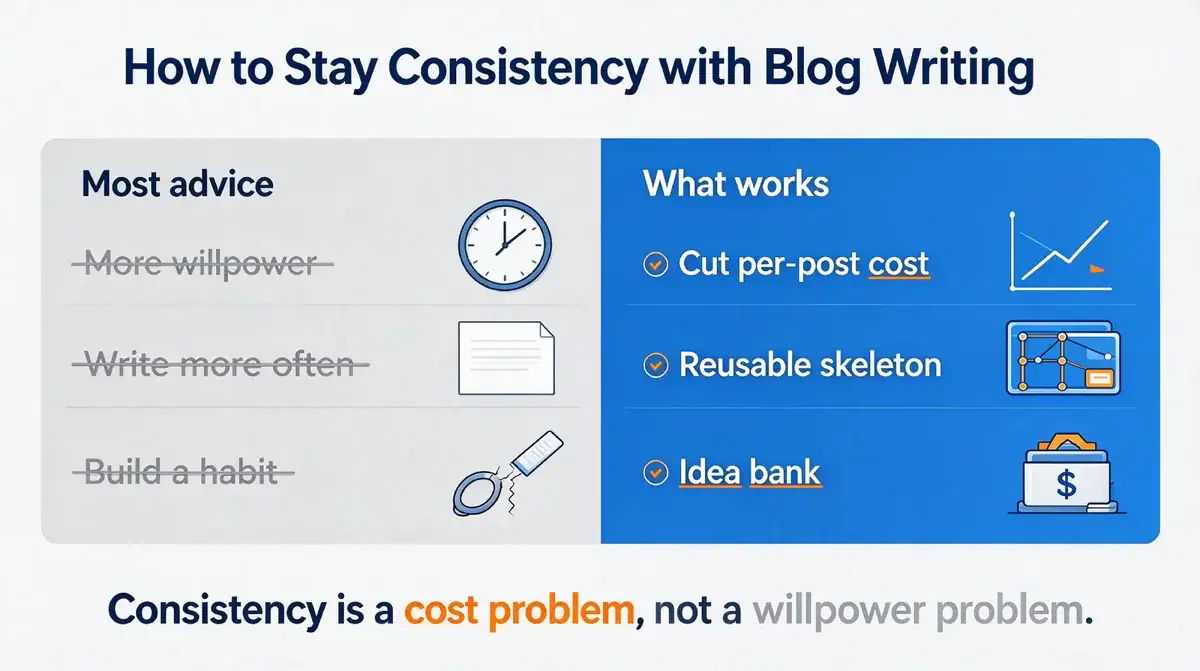
Here is the rule that fixed it for me: consistency is a cost problem, not a willpower problem. Make one post cheaper to produce and the calendar mostly takes care of itself.
Answer capsule: How to stay consistent with blog writing: stop trying to write more often and lower the cost of one post instead. Keep a reusable skeleton, keep a running idea bank, batch your writing into one block of time, and refresh an old post instead of starting from zero every week.
That same survey found only 13.9% of bloggers say their blog delivers strong results, an all-time low for the series. People are writing faster than ever and liking the outcome less. The gap isn’t effort. It’s that most of us spend our writing hours on the most expensive task there is: starting from a blank page.
Below are the 3 habits that lowered my cost per post, the mistakes that quietly push it back up, and how to check whether any of it is working. If your bottleneck is ideas rather than time, read my post on how to do keyword research first.
Why Is Cadence a Cost Problem, Not a Discipline Problem?
Cadence just means your publishing rhythm, and most advice treats it as a character test. It isn’t. Every post carries a fixed cost: pick the topic, decide the shape, write it, find images, format it, publish it. Most of us pay all six fresh, every single time.
For a beginner, the full cost breakdown of one post looks like this:
- Topic decision cost: staring at a blank page, wondering what to write
- Structure cost: outlining the post from scratch every time
- Draft cost: writing the first version
- Editing cost: rewriting, polishing, and fixing flow
- Production cost: sourcing images, formatting, and adding links
- Launch cost: scheduling, promoting, and checking performance
Most blogging advice tells you to push harder, build a habit, and just show up. It asks you to solve a cost problem with more willpower. That works for a little while, then you burn out. The better approach is to cut the parts you can decide once, and stop paying full price for every post.
Three things did most of the work for me: a skeleton, an idea bank, and batching.
What Does a Reusable Post Skeleton Look Like?
Mine is six lines: the problem in one sentence, a short direct answer, three to five sections, one thing I got wrong, one real number, one next step. I stopped deciding structure and started filling it in.
The post you’re reading used that exact skeleton: the failure up top, the answer capsule, three core habits, one cost number, one action step. I didn’t decide any of those pieces today. I decided them once, months ago, and now I just fill the slots.
A skeleton is a scaffold, not a fill-in-the-blank. Google’s official guidance on creating helpful, reliable, people-first content still asks whether your page adds original value, so the shape can repeat while the substance cannot. Google Search Central
How Do I Keep an Idea Bank Full?
One note on your phone, one line per idea, no sorting, no tagging. I add three or four a week, usually questions someone actually asked me.
The rule that makes it work: don’t start a writing session without already knowing the next three topics. Deciding what to write while you’re supposed to be writing is the single most expensive habit I had.
You don’t have to wait for inspiration. Use these triggers to fill your bank consistently:
- Reader emails and comment section questions
- Debates and disagreements in other blogs’ comment sections
- Problems you ran into while building your own blog
- Google autocomplete and related search suggestions
- Industry news and small trend shifts
Most of my entries come from reader emails, comments, and questions I get asked twice. If nobody has asked, I don’t write it yet.
Is Batching Actually Faster?
In my experience, yes. Outlining three posts in one sitting takes me maybe half the time of outlining them on three separate evenings, because I’m already holding the thread.
Batch the same stage together, not whole posts: one block for outlines, one for ugly drafts, one for editing. Switching between those modes is where my hours used to disappear.
You don’t write one post start to finish. You do all the thinking first, then all the drafting, then all the cleanup. Each mode uses a different part of your brain, and switching costs are real.
Applicability: This works best for how-to and list posts, where the shape repeats. It applies less to deep original research or personal essays, where each piece needs its own structure anyway.
How to stay consistent with blog writing usually gets easier the moment you stop paying full price for every post.
What Is a Minimum Viable Cadence?
My first schedule was weekly. I hit it for six weeks, missed one, and then didn’t publish for two months. The miss felt like failure, so I stopped.
The fix was embarrassingly simple: I set a floor instead of a target. A floor is the least you can publish and still call yourself active. Mine was one post every two weeks, and I’ve kept it for over a year.
Why Does a Floor Beat a Target?
A target punishes you for a normal week. A floor absorbs it. If you commit to two posts a month and publish three, you’re ahead; if you publish one, you’re still in the game.
Most people set their blogging schedule based on what they wish they could do. A floor is based on what you can reliably do on your worst month. That’s the difference between a streak that breaks and a habit that stays.
How Do I Pick My Number?
Work backwards from the hours you actually have, not the hours you wish you had. Two evenings a month at three hours each is roughly one post. That is a real number. “Weekly” is a wish.
I get about two genuine writing evenings a month. At roughly three hours each, that’s one solid post, maybe two if I’m reusing a skeleton and the topic is already in my bank. So my floor is one post every two weeks, which still adds up to somewhere between 12 and 24 posts a year.
What Do I Do When I Miss a Week?
Ship the next one smaller. A short post published counts; a long post abandoned doesn’t. Don’t try to make up the backlog, because that’s how one missed week becomes a quiet three-month gap.
Applicability: A floor works when you’re building a library over years. It’s the wrong frame if you’re in a short launch window with a hard deadline, where you genuinely need a burst.
Pick a floor you can hit on your worst month, and how to stay consistent with blog writing stops being a motivational problem.
Why Should Old Posts Get Some of Your Writing Time?
Here’s the part that changed how I budget my hours. Ahrefs analyzed 17 million AI citations and found that AI assistants cite content roughly 25.7% fresher than the pages showing up in classic organic results, about 1,064 days old versus 1,432 days.
One honest caveat: that preference varies a lot by platform. ChatGPT leaned strongly toward newer sources, while Google’s AI Overviews was only about 16 days fresher than organic results. So don’t read this as “change the date and win.” Read it as: keeping a page current tends to cost less than replacing it.
Content decay is the slow traffic loss an aging post suffers as competitors publish newer versions. Refreshing fights decay at a fraction of the cost of a new post, because the page already has history.
How Do I Choose Which Post to Refresh?
Open Search Console and sort by the last 16 months. Start with pages ranking roughly between positions 5 and 20. Those already have signals; they just need current details.
What Does a 30-Minute Refresh Look Like?
- Replace two outdated stats with current ones
- Add one new section answering a question the post ignores
- Rewrite the intro to match today’s search intent
- Update one screenshot and its alt text
- Leave the URL alone
One page I rewrote last year was sitting around position 14 for its main query. I spent 35 minutes replacing two stale numbers, adding a section for a question readers kept asking, and rewriting the intro. I left the URL and the internal links untouched.
Impressions on that page climbed over the following weeks. That’s one page, not a promise, but at 35 minutes it was the cheapest work I did that month.
Applicability: Refreshing pays off on posts that already get some impressions. On a post with genuinely zero traction and no links, a rewrite of the topic from scratch is usually the better use of the hour.
Some weeks the cheapest way to show first-hand experience and keep momentum is to improve a post you wrote last year. That habit is a big part of how to stay consistent with blog writing for years instead of months.
Common Pitfall vs Recommended Approach
Common pitfall: Committing to weekly posts, starting each one from a blank page, and treating the first missed week as proof you’re not cut out for this.
Recommended approach: Decide the shape once, keep three topics queued, publish on a floor you can hit on a bad month, and refresh one old post for every two new ones.
Quick Recap Checklist
Before you publish, run this quick pass: how to stay consistent with blog writing comes down to five checks.
- Accept the break. No self-punishment, no “I need to catch up.”
- Pick the easiest topic from your idea bank — no ambition, just momentum.
- Draft it fast using your skeleton. Don’t aim for perfect.
- Publish and don’t check stats for 48 hours. Avoid negative feedback loops.
- Bring quality back up on the second post, not the first.
The rule: rebuild the rhythm first, then rebuild the standard.
Mistake 3: Doing Every Single Step Yourself
Writing, opinions, and the tested details are yours. Formatting, image prep, proofreading, and publishing cleanup are not the reason you started a blog, and they’re the parts that quietly eat an hour per post.
On the labor side, here’s where I draw the line. The ideas, the testing, and the opinions stay with me. What I hand off is the hour of assembly around each post: formatting the draft, sourcing and compressing images, proofreading, and scheduling. I’ve used Fiverr for that kind of recurring prep work, and it’s a good fit when you have a steady backlog of 5 or more posts a month to process. It’s a poor fit if you publish once a month, or if you’re hoping someone else will come up with the ideas. Fiverr is a freelance marketplace, so quality varies by seller; ask for samples and start with one small task before committing.
Note: these are experience-based recommendations, not Google rules.
How to Track Your Progress
Track the input, not just the output. Publishing count is a lagging signal; cost per post is the one you can actually control this month.
- Time one post start to finish this week. Write the number down.
- Next month, time one again after using your skeleton. Compare.
- In Search Console, filter the last 16 months and note any page sitting between positions 5 and 20.
- Refresh one of those pages and check impressions again after 4 to 8 weeks.
What to look for: your hours per post dropping while impressions hold or climb. If hours drop and traffic drops with them, you’ve cut the wrong step, usually the research or the testing.
FAQ
How often should I blog to stay consistent?
Why do I keep failing to blog consistently?
How do I get back into blogging after a long break?
Is it better to update old posts or write new ones?
How do I beat writer’s block and stay consistent?
Can you be consistent with blogging with a full time job?
FAQ structure helps Google parse your content hierarchy and makes answers easier for readers to find.
Final Thoughts
How to stay consistent with blog writing comes down to lowering the price of one post. You don’t need more discipline or a tighter schedule to figure out how to stay consistent with blog writing. Reuse the shape, keep topics queued, publish on a floor, and let old posts carry some of the load. Keep the rule close: consistency is a cost problem, not a willpower problem.
5-Minute Action Step: Open a note on your phone and write down three topics you could publish next, one line each. That’s your idea bank, and it’s the cheapest thing on this page.
Next, I’ll break down how to audit a year’s worth of old posts in one afternoon, so you know exactly which ones deserve a refresh. Meanwhile, this pairs well with how to get cited in Google AI Overviews and how to keep visitors on your blog.